Somewhat shocked to find the screw worked. And I was able to thread it with my fingers the entire length. It did cinch down tight at the end, though. I'm wondering if that's too loose...?
Then I cut 3 more screws to see how the die would hold up. By the 3rd one (4th overall) it was getting a bit hard to get the screw to bite in at first. Also seemed like the screw was turning crookedly.
Yet the finished screw looked good, with clean threads at the right pitch.
It would be perfect if these socket screws weren't hardened alloy, but they don't seem to sell them any other way. And I can't find regular pan heads in #12-28 either.
Still, if you could cut a half dozen screws before the die gave out, you'd still come out a little ahead of eBay.
Showing posts with label JIS. Show all posts
Monday, April 28, 2014
Sunday, April 27, 2014
Roxy: DIY 5mm JIS Screws Continued
Ok, the second attempt to cut these 5mm JIS screws. This time using #12-28 socket cap screws. Amazingly, the #12-28 pitch is almost exactly 0.9 to begin with. The problem is just that the screw is much bigger than 5mm, so you have to remove a lot of material.
Turning it through the die was definitely work, and you can feel the metal cutting. Was worried how well the die itself would hold up cutting the alloy.
The screw before cutting. It's already 0.9 to start.
About halfway through and you can see how much material has to be removed.
Compared to the original.
Now I just have to TEST IT...
Turning it through the die was definitely work, and you can feel the metal cutting. Was worried how well the die itself would hold up cutting the alloy.
The screw before cutting. It's already 0.9 to start.
About halfway through and you can see how much material has to be removed.
The finished screw.
Compared to the original.
Checking the pitch on the gauge.
Now I just have to TEST IT...
Labels:
1964 S90,
DIY,
fabrication,
JIS
Wednesday, April 9, 2014
Aw Nuts
Lesson learned: not all steel is created equal - check the grade!! I had high hopes that I'd be able to cut the 5mm JIS screws, but ended up killing the die instead.
I found a couple of socket cap screws (#4 hex) at ACE that had a good length of un-threaded metal.
For my first attempt, I cut the screw thinking that I could just get the unthreaded part to bite into the die. But it wouldn't catch (and I only realized why later).
So then I tried cutting most of the length, but leaving enough thread so I could get it started in the die.
Then start cutting. This was all going very well until the screw seemed to turn without moving. I figured it had just hit the unthreaded metal and needed more downward pressure. I was wrong.
Had to knock the screw back out with the ball peen. Upon inspection, it looks like the threads pulled the metal down but instead of being cut, it simply flattened the grooves in the die.
Could it be because it was 12.9 grade steel?
I found a couple of socket cap screws (#4 hex) at ACE that had a good length of un-threaded metal.
For my first attempt, I cut the screw thinking that I could just get the unthreaded part to bite into the die. But it wouldn't catch (and I only realized why later).
So then I tried cutting most of the length, but leaving enough thread so I could get it started in the die.
Then start cutting. This was all going very well until the screw seemed to turn without moving. I figured it had just hit the unthreaded metal and needed more downward pressure. I was wrong.
Had to knock the screw back out with the ball peen. Upon inspection, it looks like the threads pulled the metal down but instead of being cut, it simply flattened the grooves in the die.
Could it be because it was 12.9 grade steel?
Monday, April 7, 2014
Roxy: DIY JIS Screws, First Attempt
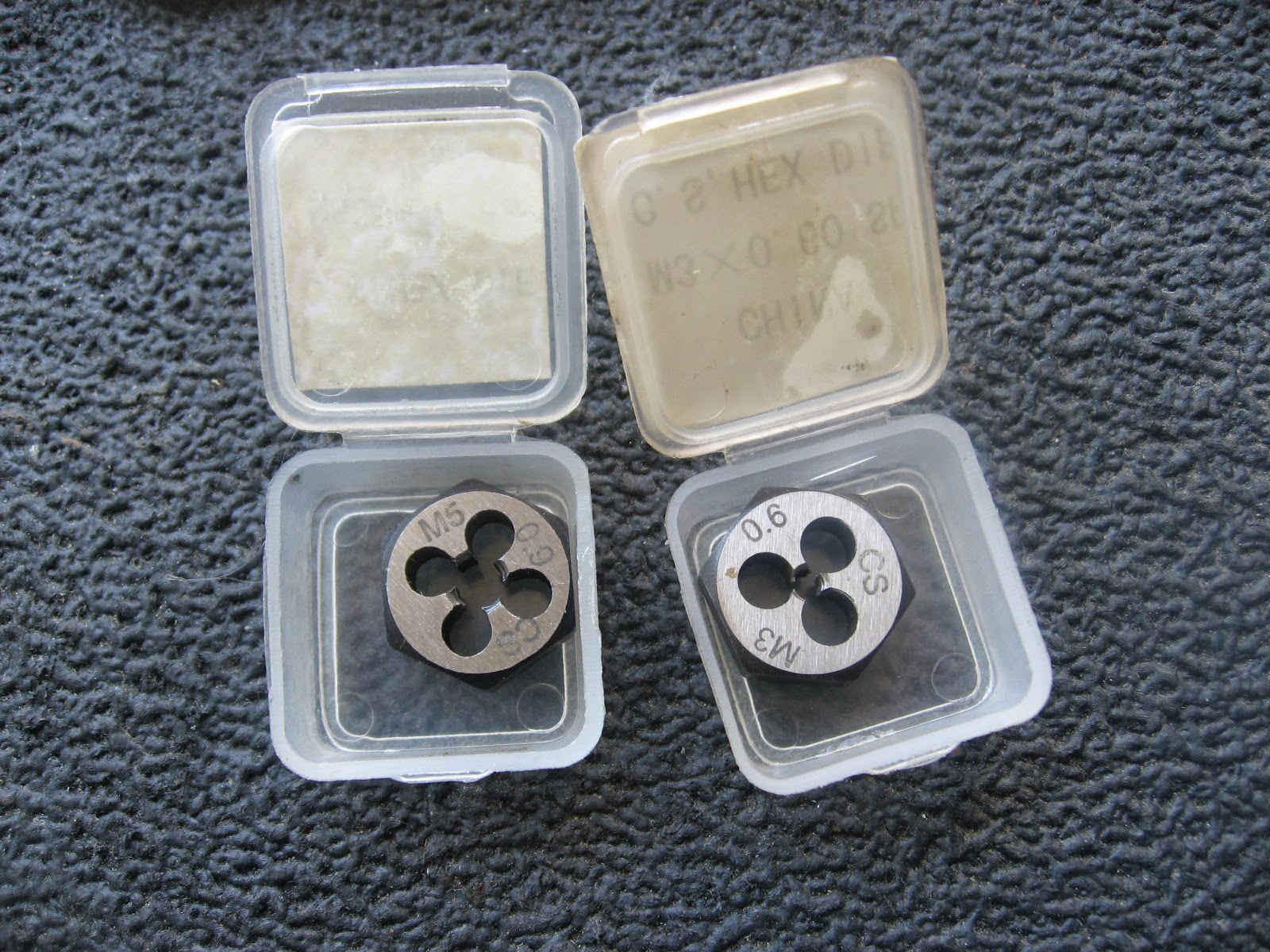
Received 2 new dies today: 5mm 0.9 pitch and 3mm 0.6 pitch. Once again hoping to free myself from outrageous eBay prices.
First test was to try to cut a 5x10 screw for the points plate. I held the die in place with the socket wrench, while turning it with the JIS vessel screwdriver. Luckily, I was able to turn it by hand through the entire length.
I used a little WD40 as lube, and I would back off and resume any time it started to get hard to turn. Toward the end, I had to switch to holding it with a box wrench, as I think it bottomed out in the socket. But even then, it just took a little elbow grease.
When I was done, the screw turned very easily in the die. But checking it against the thread gauge, it was definitely not a clean 0.9 pitch. It wasn't 0.8, either, so the die definitely recut it a bit - just not enough.
I could hand thread it three full turns in the actual hole (points plate), but I didn't dare force it any further than that.
Asked for advice on Yahoo Groups and a good suggestion came back: find a long screw that has solid metal between the head and the threads. Cut the threads off, then use that to cut fresh new threads in the die.
So there's still some hope...
Also, the screws that hold the points to the plate are 4mm x 6-ish at 0.7 pitch (ie, NOT JIS). And note they have both a split ring and a regular washer.
First test was to try to cut a 5x10 screw for the points plate. I held the die in place with the socket wrench, while turning it with the JIS vessel screwdriver. Luckily, I was able to turn it by hand through the entire length.
I used a little WD40 as lube, and I would back off and resume any time it started to get hard to turn. Toward the end, I had to switch to holding it with a box wrench, as I think it bottomed out in the socket. But even then, it just took a little elbow grease.
When I was done, the screw turned very easily in the die. But checking it against the thread gauge, it was definitely not a clean 0.9 pitch. It wasn't 0.8, either, so the die definitely recut it a bit - just not enough.
I could hand thread it three full turns in the actual hole (points plate), but I didn't dare force it any further than that.
Asked for advice on Yahoo Groups and a good suggestion came back: find a long screw that has solid metal between the head and the threads. Cut the threads off, then use that to cut fresh new threads in the die.
So there's still some hope...
Also, the screws that hold the points to the plate are 4mm x 6-ish at 0.7 pitch (ie, NOT JIS). And note they have both a split ring and a regular washer.
Subscribe to:
Posts (Atom)